On this page
To travel with children, plan the trip around their ages, book flights and seats early, pack by system instead of by panic, and keep every child's documents ready before you leave. Then slow the pace: fewer moves, longer stays, and one main activity a day are what make a family trip work for everyone.
Traveling by age
The single biggest factor in how a trip goes is your child’s age, so plan the trip around it instead of around the destination. A plan that works for an 8-year-old will exhaust a 2-year-old, and a baby’s trip looks nothing like a teen’s. Use the table as a starting point, then read the section for your child.
| Age | Biggest challenge | What works | Flight seat | Best trip style |
|---|---|---|---|---|
| Baby (0–12 months) | Feeding, sleep, gear volume | Feed on takeoff and landing, keep naps on schedule | Lap infant or own seat with approved car seat | 1 base, 5–7 nights, short flights |
| Toddler (1–3 years) | Can’t sit still, strong opinions | Short legs of travel, snacks, new small toys | Lap until 2, then own seat; car seat recommended | 1–2 bases, flights under 5 hours |
| School-age (4–12 years) | Boredom, school calendar | Give them a job, a backpack, and a say in plans | Own seat; booster not allowed for takeoff/landing | Road trips, 2–3 bases, 1–2 weeks |
| Teen (13–17 years) | Engagement, privacy | Let them plan a day, give some independence | Own seat | Cities, active trips, longer itineraries |
Babies (0–12 months)
Babies are more portable than they look. Before they crawl, most sleep in a carrier or stroller and eat on your schedule. The hard part is gear and sleep, not the baby.
Book flights around naps, keep a bottle or breast ready for takeoff and landing, and pick one base with a separate sleeping area. On US domestic flights, a lap infant usually flies free, but the safest option is an approved car seat in a purchased seat. Our full guide to flying with a baby covers every step, flying with a newborn covers the first three months, and the baby packing list keeps the gear under control. If you are pumping, see traveling with a breast pump.
Toddlers (1–3 years)
Toddlers are the hardest age to travel with, and that is normal. They want to move, they don’t understand waiting, and their sleep is easy to break. Plan for it instead of fighting it.
Keep travel days short, with flights under about 5 hours where you can. Pack new small toys wrapped in paper, twice the snacks you think you need, and a change of clothes for them and for you.
Once a child turns 2, they need their own seat. See flying with a toddler and the toddler packing list.
School-age kids (4–12 years)
School-age kids are the easiest travelers. They can carry their own backpack, sit through a 3-hour drive, and actually enjoy museums, hikes, and new food. The main constraints are boredom and the school calendar.
Give each child a job, like navigator, photographer, or snack keeper, and let them choose one activity per trip. Road trips work well at this age.
Kids still under 40 lb (18 kg) should use an approved car seat on the plane, and booster seats cannot be used during taxi, takeoff, or landing. Use the kids packing list.
Teens (13–17 years)
Teens travel like adults, with stronger opinions. The challenge is engagement, not logistics. Screens are the default, so give them a real reason to look up.
Let each teen plan one full day, including the budget. Build in some independence, like an afternoon exploring with a sibling in a safe area. Teens 16 and 17 get a 10-year US passport, and they may need ID on their own if they travel without an adult.
Booking flights and seats
Book family flights early, choose nonstop routes, and decide lap versus seat before you look at prices. Most of the stress on a family flight is set at booking: seat location, connection time, and departure time. Get those right and the flight itself is much easier.
Lap infant or own seat
Children under 2 can fly on a parent’s lap. On US domestic flights that is usually free apart from taxes or fees, and on international flights it typically costs around 10% of the adult fare plus taxes. Only one lap infant is allowed per adult, and the child must be under 2 on every flight, including the return.
The FAA strongly recommends that any child under 40 lb (18 kg) ride in an approved car seat or harness in their own seat. That is the safest place for a child on a plane. If you buy the seat, you can bring an approved car seat on board; see traveling with a car seat for labels, sizes, what flight attendants can and cannot ask, and car seats in taxis and rental cars.
| Option | Cost | Pros | Cons |
|---|---|---|---|
| Lap infant | Free domestic (fees may apply), ~10% international | Cheapest, no car seat to carry | Less safe in turbulence, no space, tiring on long flights |
| Own seat + car seat | Full or discounted fare | Safest, familiar seat, baby may nap | Cost, carrying the seat through the airport |
| Own seat, no car seat | Full or discounted fare | Extra space for older toddlers | Child under 40 lb less protected |
When to book
Book 2 to 4 months ahead for domestic trips and 3 to 6 months ahead for international ones, and earlier for school holidays. Early booking matters more for families than for solo travelers, because you need several seats together. Fares for 4 people rise faster than fares for 1.
Seats and family seating
Choose seats at booking, even if it costs a little. Many US airlines have committed to fee-free adjacent seating for a child 13 and under with an accompanying adult, but conditions apply, so book early and check the DOT family seating dashboard and your airline.
Car seats must go in a window seat and never in an exit row or the rows just in front of or behind it. A window and middle for a parent and young child works well. Families of 4 often do best splitting 2 and 2 across the aisle in the same row.
Nonstop versus layovers
Pay for nonstop when you can. Every connection adds a chance of a missed flight, a lost bag, and a meltdown in a terminal. If you must connect, leave at least 90 minutes domestic and 2 to 3 hours international.
A long layover can also be a feature. A 4-hour stop with a play area can break a long trip into 2 easy flights for a toddler.
Time of day
Early morning flights are often the most reliable, and many kids are at their best then. Evening or overnight flights can work for long-haul trips if your child sleeps well away from home.
Avoid departures that fall right at nap time unless your child reliably sleeps on planes. For more ways to cut airfare, see family travel on a budget.
The packing system
Pack by system, not by room or by panic. Split everything into 6 groups: documents, clothing, health, gear, entertainment, and snacks. Each group gets its own bag or pouch, so you always know what you have and where it is.
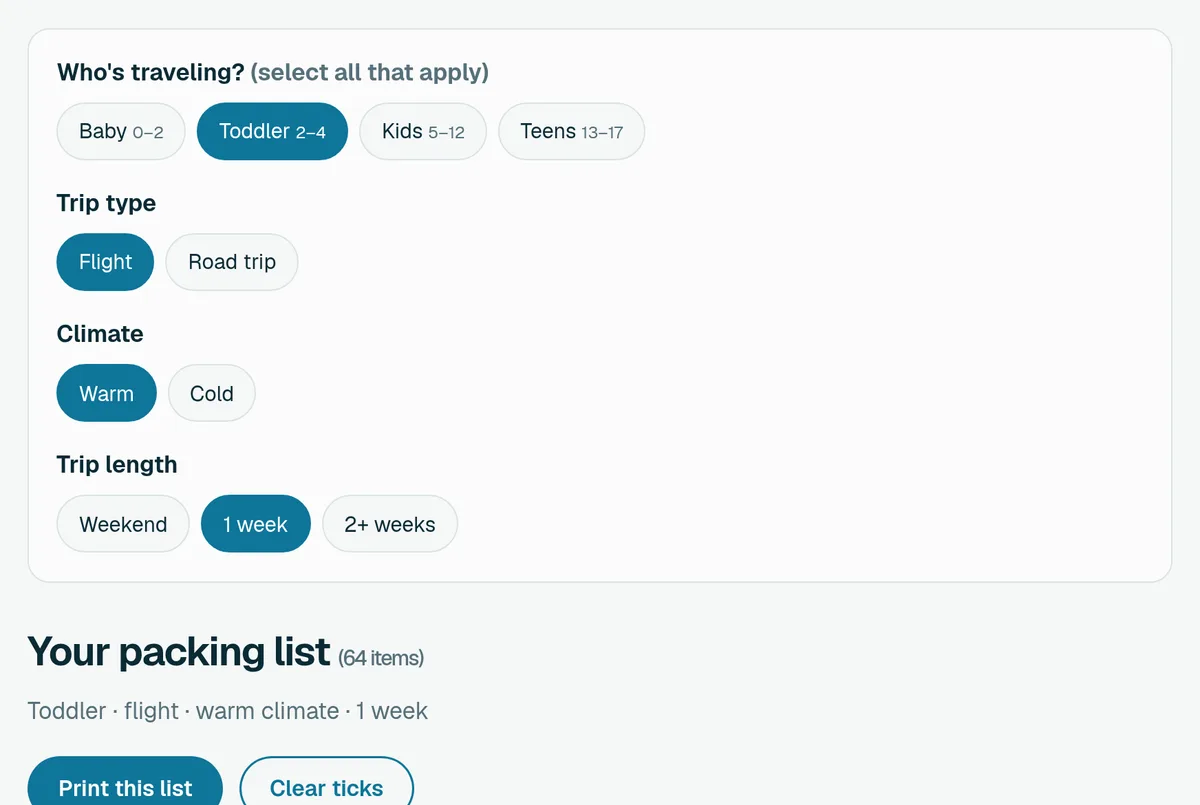
Our Family Packing List Generator builds a list for your trip in these 6 groups. Enter each child’s age, trip type, climate, and length, and it gives you a printable checklist in under a minute.
The 6 groups
| Group | What goes in | Where it lives |
|---|---|---|
| Documents | Passports, IDs, birth certificate copies, consent letter, insurance, bookings | One pouch, carried by one adult |
| Clothing | Outfits, sleepwear, layers, swimwear | One packing cube per child |
| Health | First-aid basics, prescriptions, thermometer, sunscreen | One pouch in the carry-on |
| Gear | Stroller, car seat, carrier, travel crib, sound machine | Checked or gate-checked |
| Entertainment | Tablet, headphones, books, small new toys | Each child’s backpack |
| Snacks | Dry snacks, water bottles, formula or milk | Carry-on, easy to reach |
One bag per kid
Give each child 1 packing cube or 1 small bag for clothes, labeled with their name. Kids from about age 4 can carry their own backpack with entertainment, a water bottle, and a snack. That one rule stops most of the “where is his other shoe” hunting.
Pack for 5 to 7 days at most, even for longer trips. Beyond that, do laundry.
Carry-on essentials
Your carry-on should get you through 24 hours if checked bags are lost. That means a full change of clothes for each child, a spare shirt for each adult, all medications, diapers and wipes for the travel day plus 50%, snacks, and chargers. Keep formula and milk easy to pull out for the security line.
Laundry math
Count days, not outfits. For babies and toddlers, pack 1.5 to 2 outfits per day up to 5 days. For school-age kids, pack 1 outfit per day up to 5 to 7 days, plus 1 spare.
Then book a place with a washer or plan a laundromat stop every 5 to 7 days.
Printable lists
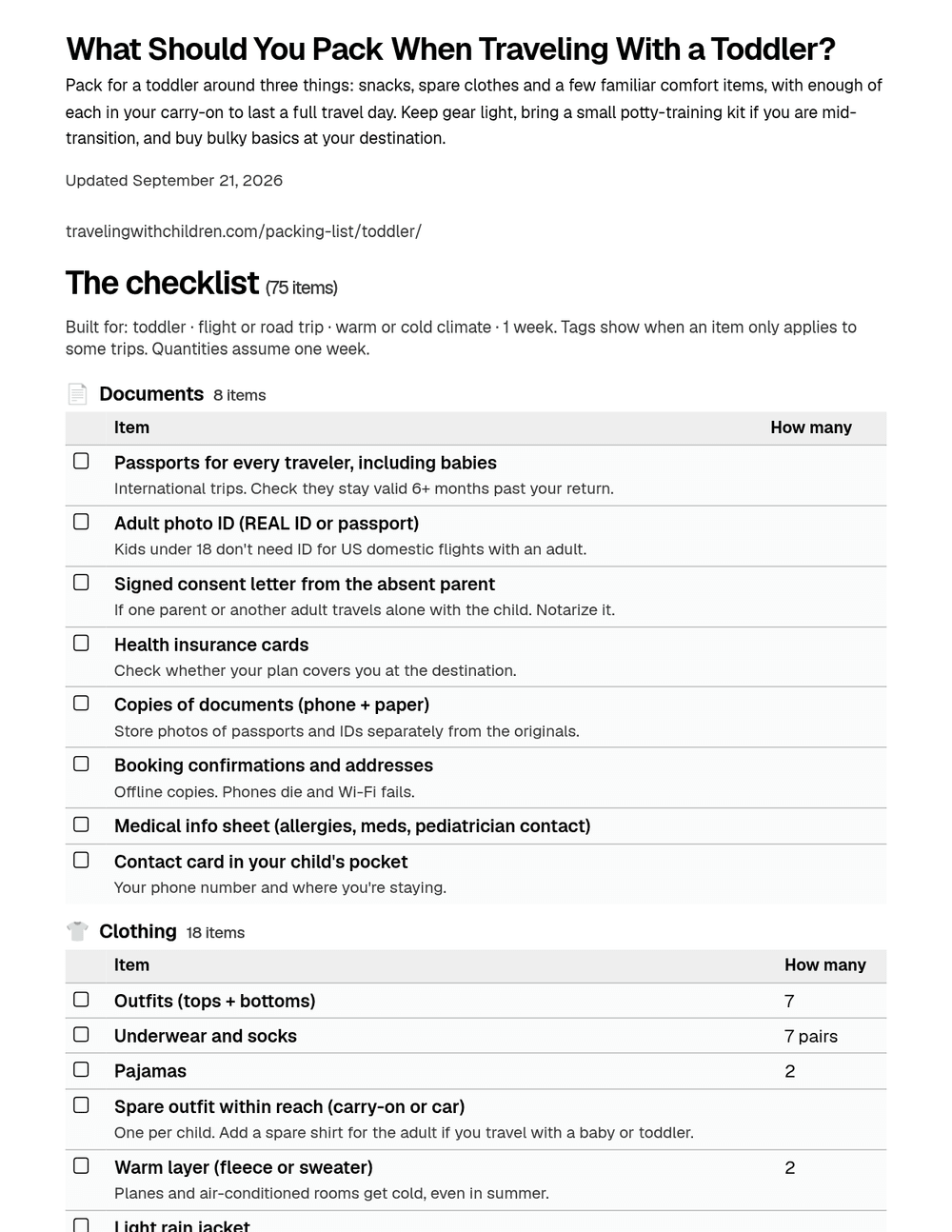
Prefer a fixed checklist? Print one of these and cross items off as you pack:
- Baby packing list
- Toddler packing list
- Kids packing list
- Road trip packing list
- Beach packing list
- Winter packing list
Documents kids need
What documents a child needs depends on where you are going and who is traveling with them. Domestic US flights need the least, international trips need a passport for every child, and a child traveling with one parent may need a consent letter. Check requirements at least 3 months before you leave.
| Scenario | What the child needs | Notes |
|---|---|---|
| US domestic flight with an adult | No ID required by TSA for under 18 | The adult needs REAL ID-compliant ID or a passport |
| Lap infant on any flight | Proof of age, like a birth certificate copy | Airlines may ask to confirm the child is under 2 |
| International trip | The child’s own passport, plus any visa | Newborns need a passport too; check passport validity rules |
| Traveling with one parent | Passport plus a signed consent letter from the other parent | Not required by US law but widely recommended; notarize it |
| Destination with strict minor rules | Extra documents, sometimes a certified birth certificate | Check the destination’s embassy website |
US children under 16 apply for a passport in person with form DS-11, and both parents or guardians must consent. If one parent can’t attend, they sign a notarized form DS-3053. These passports are valid for 5 years, while passports for ages 16 and 17 are valid for 10.
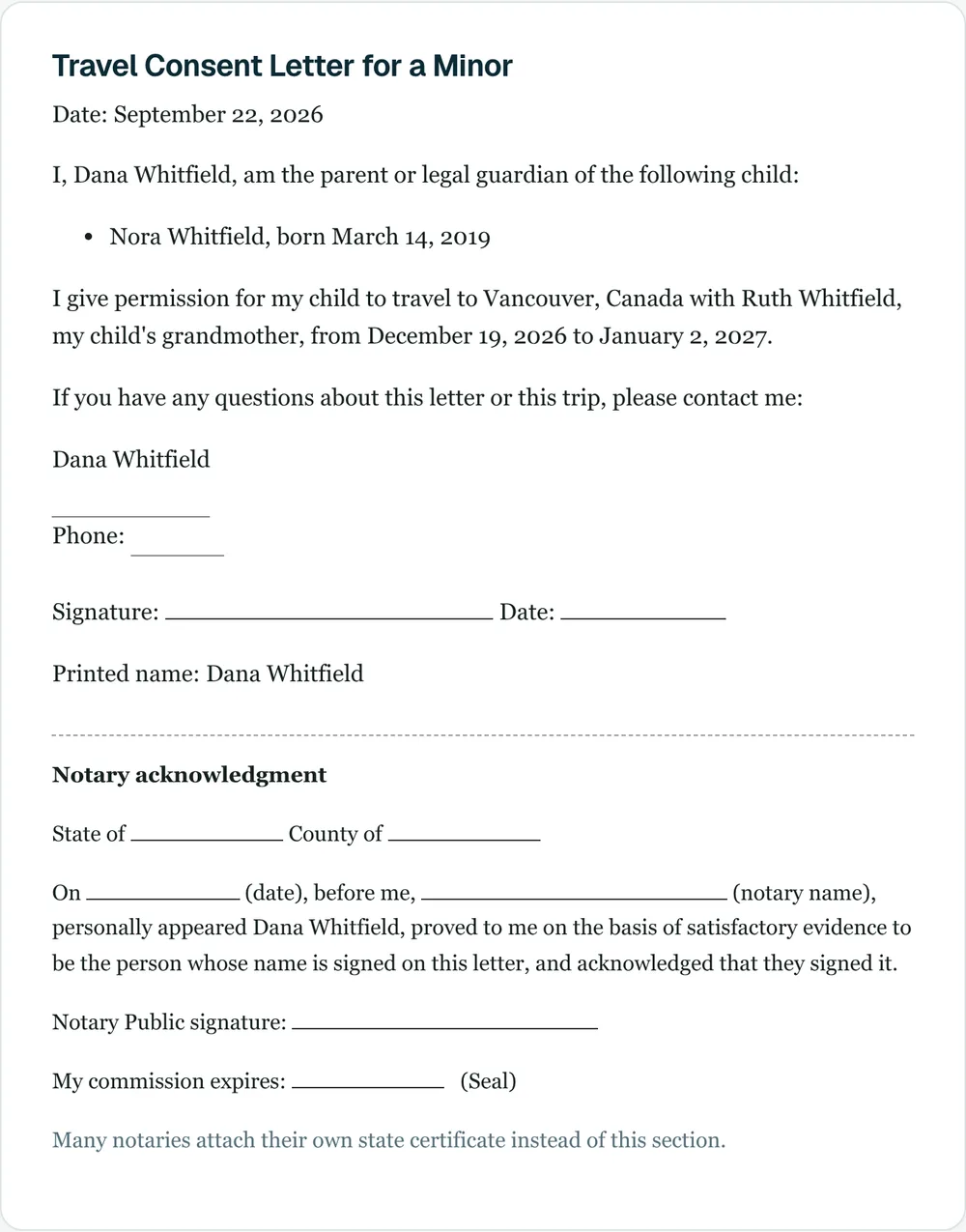
Routine processing takes weeks, so apply 2 to 3 months before travel as a safe buffer. Fees and times change, so check travel.state.gov before you apply. Our full guide to travel documents for children covers every scenario, and the free travel consent letter generator prints a ready-to-sign letter. If your child will fly alone, read how unaccompanied minor programs work.
Surviving the journey
The travel day is the hardest day of most family trips, so plan it separately from the rest. Keep it simple: short legs, food and entertainment in reach, and low expectations for the day. Getting there calmly counts as a win.
Flights
Arrive early enough to walk, not run. With kids, that means about 2 hours before a domestic flight and 3 hours before an international one. Let kids burn energy in the terminal, then board as late as your seat setup allows, unless you need time to install a car seat.
At security, kids 12 and under can generally keep their shoes on. Declare formula, milk, and baby food, and have them easy to pull out. Strollers and car seats are generally checked free on US airlines, at the counter or the gate. Our guide to flying with a stroller covers gate-check tags, size limits and damage.
On board, pace the entertainment. Hand out one new activity every 30 to 45 minutes instead of everything at takeoff. Our guide to keeping kids entertained on flights has ideas by age, and flying with a toddler covers the hardest age in detail.
For ears, encourage swallowing during descent: a bottle, breast, or pacifier for babies, water or a snack for older kids. If a child has a cold or ear infection, ask your pediatrician before flying.
Road trips
Plan a stop every 2 hours, and every 1.5 to 2 hours with babies and toddlers. Aim for 4 to 6 hours of driving per day with young kids. Kids who travel well can handle more, but the pace should suit the youngest child in the car.
Leave early in the morning or at nap time so part of the drive happens while kids sleep. Keep a small bag in reach with snacks, wipes, a change of clothes, and a sick bag.
Every child should ride in the right car seat or booster for their size, every time. Our road trips with kids guide covers routes, stops, and car games.
Where to stay
For most families, a rental apartment or a hotel suite beats a standard hotel room. The main reason is sleep: if kids go to bed at 7 p.m. in the same room as you, your evening ends at 7 p.m. too. A second room, a kitchen, and a washer change the whole trip.
| Option | Best for | Pros | Cons |
|---|---|---|---|
| Rental apartment | Stays of 4+ nights, babies and toddlers | Separate bedrooms, kitchen, washer | Cleaning fees, fewer services, check crib availability |
| Hotel suite | Short stays, city trips | Separate living area, breakfast, front desk | Higher price, small or no kitchen |
| Standard hotel room | 1–2 night stops | Easy, flexible, often a pool | Shared sleep space, eating out every meal |
| Family resort | Beach or pool holidays | Kids’ clubs, everything on site | Expensive, less local |
What to look for
Put bedroom separation first. Kids nap and sleep better in a dark room of their own, and you get your evenings back. A walk-in closet or bathroom can work as a crib space in a pinch, if it is safe and ventilated.
Next, a kitchen or at least a fridge and microwave. Breakfast and one other meal at “home” save money and meltdowns. A washer lets you pack half as much.
Then location. A playground or park within a 5-minute walk is worth more than a famous view. So is a grocery store nearby and a short trip to the main sights.
Cribs and sleep setup
Ask whether the property has a crib or pack-n-play, and ask for its condition. Many families bring their own travel crib or a lightweight sleep tent for babies and toddlers, so the child sleeps in something familiar. Pack the usual sleep cues too: the same sleep sack, sound machine, and bedtime book as at home.
Health basics on the road
Staying healthy on a family trip is mostly preparation: a small health kit, a pediatrician check before international travel, and attention to water, sun, and sleep. This section gives general guidance only. For anything about your own child’s health or medication, ask your pediatrician.
A travel health kit
Keep one pouch in your carry-on with the basics:
- Thermometer
- Bandages, antiseptic wipes, and tweezers
- Any prescription medications, in original packaging, with enough for the trip plus a few days
- Fever and pain relievers your pediatrician has approved for your child, with their dosing guidance
- Oral rehydration packets
- Sunscreen, insect repellent suitable for your child’s age, and after-sun lotion
- Copies of prescriptions and your pediatrician’s contact details
Don’t give any medication to make a child sleep on a flight. If you’re thinking about it, talk to your pediatrician first.
Before international trips
Book a pediatrician visit 4 to 6 weeks before an international trip. Ask whether your child’s routine vaccines are up to date, whether the destination calls for any others, and what to pack for your child’s specific needs. The CDC travel health pages list recommendations by destination.
Water, sun, and motion sickness
Kids dehydrate faster than adults, especially on planes, in heat, and with stomach bugs. Offer water often, and use bottled or treated water where tap water isn’t safe to drink. Keep babies under 6 months out of direct sun, and use shade, hats, and clothing for all kids.
For motion sickness, seat kids where they can look out the front window, keep the car cool, avoid heavy meals before travel, and limit screens and books in the car. If it’s a regular problem, ask your pediatrician what options fit your child.
Jet lag
A rough rule of thumb is one day to adjust per time zone crossed, and traveling east is usually harder. Shift bedtime by 15 to 30 minutes a day for a few days before you leave, and get outside in daylight on arrival. See jet lag in children for a full plan.
Insurance and care abroad
Check whether your health insurance covers your children abroad. Many US plans offer limited or no coverage outside the country, so consider travel medical insurance for international trips.
Before you go, note the nearest hospital or urgent care to where you are staying and save the local emergency number in your phone. The US embassy website for your destination often lists local doctors.
Budgeting a family trip
A family trip costs more than a solo trip mainly because of seats and beds: every child is another airfare, and you often need more space to sleep. Food and activities come next. Control those 4 costs and the rest of the budget takes care of itself.
Where the money goes
For most family trips, the largest costs are:
- Transportation. Flights for 4 or more people are usually the biggest line.
- Lodging. Space for kids to sleep separately costs more than a standard room.
- Food. Eating out 3 times a day for a family adds up fast.
- Activities. Tickets priced per person, even for young kids.
The levers that matter
| Lever | Typical effect | Trade-off |
|---|---|---|
| Drive instead of fly | Large savings for 4+ people on trips under ~6 hours of driving | Longer travel day |
| Travel off-peak | Lower fares and rates outside school holidays | Limited by the school calendar |
| Stay longer in one place | Weekly rental discounts, fewer transport costs | Less variety |
| Book a kitchen | Cook breakfast and 1 other meal | Some cooking on holiday |
| Use free activities | Parks, beaches, playgrounds, free museum days | Plan around free hours |
| Use points and miles | Can cover flights or nights | Takes planning and discipline |
| Lap infant under 2 | Free or low-cost fare | Less safe, less comfortable |
The biggest single lever is time. Going 2 weeks before or after a school holiday can cut the cost of flights and lodging noticeably, when your school calendar allows it. Our guide to family travel on a budget goes through each lever in detail.
Pacing: the slow-travel rule
The rule is simple: one big thing a day, at least 3 nights in each place, and a rest day every 4 to 5 days. That pace sounds slow, and it is. It is also the single change that makes family trips work.
Why one big thing a day
Kids have a limited amount of energy for new places, lines, and rules. Spend it on one main activity, like a museum, a hike, or a day at the beach, ideally in the morning. Fill the rest of the day with low-effort time: a playground, a long lunch, a swim, a nap.
If a day goes well, you can add something. If it goes badly, you still did the one thing that mattered.
Why fewer bases
Every move costs half a day: packing, checkout, travel, finding food, and settling a child into a new bed. Staying at least 3 nights per base, and 5 to 7 with babies and toddlers, cuts those costs. Kids sleep better once a place feels familiar, usually by the second night.
A good template for a 2-week trip with young kids is 2 bases, not 5. School-age kids and teens can handle 3.
Why rest days
Rest days are when trips start to feel like holidays. No plans, no tickets, no schedule: breakfast in pajamas, a local park, maybe a swim. They keep everyone’s reserves from running out, and they are often the days kids remember best.
The point of it
A slower trip gives you something a packed one can’t: time together without the usual pressures of work, school, and home. You notice what your kids find interesting. They see you relaxed.
The trip doesn’t need to be perfect. It needs to be realistic, well-prepared, and slow enough to enjoy. Start with one trip, plan it around your youngest child, and let the pace do the rest.
One big thing a day.
The slow-travel rule: fewer moves, longer stays, rest days built in. It keeps trips with kids good for everyone.
Frequently asked questions
What is the best age to start traveling with kids?
There is no single best age. Many parents find the window from about 3 to 9 months easy, because babies nap anywhere and don't crawl yet, and ages 5 and up easier again once kids can carry a backpack and wait in line. Ages 1 to 3 are the hardest stretch, but still very doable with shorter trips and a slower pace.
Do toddlers fly free?
Children under 2 can usually fly free on US domestic flights as a lap infant, though taxes or fees may apply. On international flights, a lap infant typically costs around 10% of the adult fare plus taxes. Once a child turns 2, they need their own paid seat, including on the return flight if their birthday falls during the trip.
Does a 2-year-old need their own seat on a plane?
Yes. Airlines require a paid seat for any child who has turned 2, and the child must be under 2 on every flight to travel as a lap infant. The FAA also recommends that any child under 40 lb (18 kg) ride in an approved car seat or harness in their own seat, whatever their age.
Does a baby need a passport?
Yes, for international travel every child needs their own passport, including newborns. US children under 16 apply in person with form DS-11, and both parents or guardians must consent. Apply at least 2 to 3 months before your trip and check current fees and processing times on travel.state.gov.
Can a baby fly at a few weeks old?
The American Academy of Pediatrics suggests waiting until 2 to 3 months when you can, and says flying is generally safe for healthy newborns from about 7 days old. Airlines set their own minimum age, often a few days to 2 weeks, sometimes with a medical note for the youngest. Check with your airline and ask your pediatrician, especially for a premature baby or any health concern.
Do kids need ID to fly domestically in the US?
No. TSA does not require travelers under 18 to show ID on domestic flights when they travel with an adult companion. The adult needs a REAL ID-compliant ID or passport. Airlines may still ask for proof of age for a lap infant, so carry a copy of the birth certificate.
Can you bring breast milk or formula through airport security?
Yes. TSA allows formula, breast milk, toddler juice, and baby food in reasonable quantities above 3.4 oz (100 ml) in your carry-on. Take them out and declare them to the officer at screening, and expect some extra checks. Rules can change, so confirm on tsa.gov before you fly.
Is it better to fly or drive with young kids?
For trips under about 5 to 6 hours of driving, driving is often easier and cheaper for a family of 4, since you control the schedule and stops. Beyond that, flying usually wins on total time and fatigue. With a baby or toddler, plan a stop every 2 hours when driving.
How do you help a child's ears on a plane?
Swallowing helps equalize ear pressure. Offer a breast, bottle, or pacifier to babies, and water, a snack, or a lollipop to older kids during descent, which is usually when ears hurt most. If your child has a cold or ear infection before a flight, ask your pediatrician whether it is safe to fly.
Is it worth traveling with kids who won't remember it?
Yes, for most families. Young kids may not remember specific trips, but they gain time with you, new routines, and practice adapting, and you keep the memories. Trips also get easier each time a child travels, so early practice pays off later.
What age is hardest to travel with kids?
For most families it is roughly 1 to 3 years old. Toddlers want to move, can't sit still for long and don't respond to reasoning yet, and from age 2 they need their own paid seat. Babies under about 6 months are often easier on planes because they sleep a lot, and travel gets steadily easier from about age 5. See flying with a toddler.